Committees and commissions play a major role in India’s governance system. UPSC regularly asks questions about their formation, recommendations, chairpersons, and impact on public policy. Understanding these bodies helps candidates prepare effectively for Polity, Governance, Economy, Social Justice, and Current Affairs sections.
This guide covers the most important committees and commissions for UPSC along with their recommendations and significance.
Important Committees & Commissions for UPSC
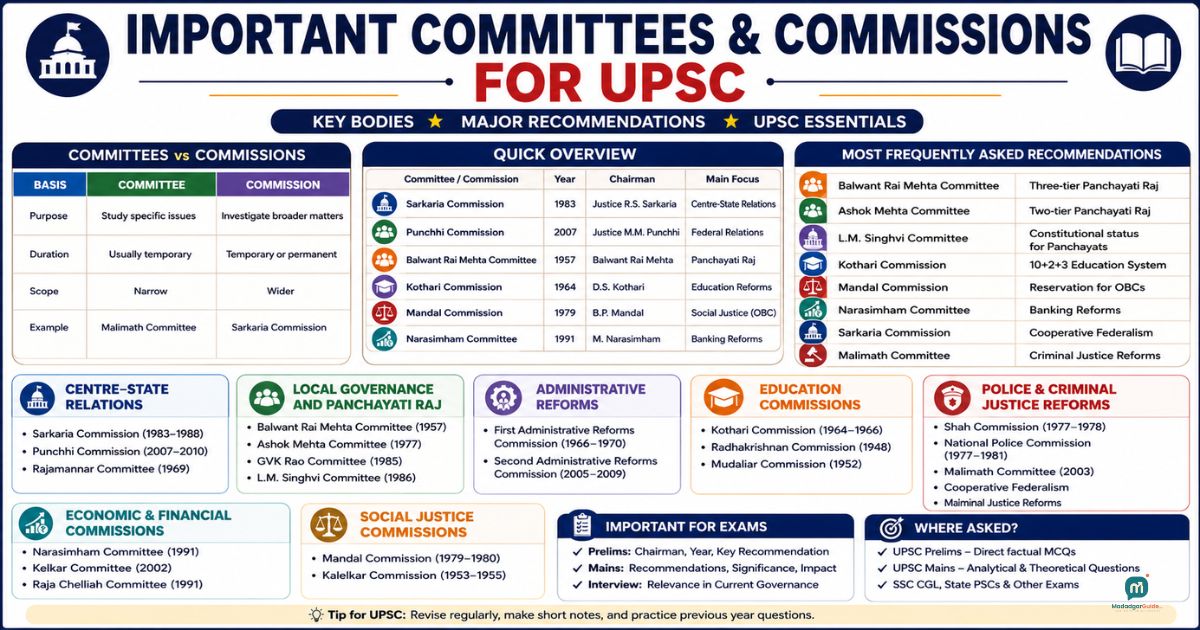
Quick Overview Table
| Committee/Commission | Year | Chairman | Main Focus |
| Sarkaria Commission | 1983 | Justice R.S. Sarkaria | Centre-State Relations |
| Punchhi Commission | 2007 | Justice M.M. Punchhi | Federal Relations |
| Balwant Rai Mehta Committee | 1957 | Balwant Rai Mehta | Panchayati Raj |
| Kothari Commission | 1964 | D.S. Kothari | Education Reforms |
| Mandal Commission | 1979 | B.P. Mandal | OBC Reservation |
| Narasimham Committee | 1991 | M. Narasimham | Banking Reforms |
Important Committees and Commissions in India for UPSC PDF
Important Committees and Commissions in India for UPSC PDF
Download the complete UPSC revision notes in PDF format.
⬇ Download PDFMany UPSC aspirants prepare committee and commission notes in PDF format because these topics are highly factual. A well-organized PDF should include the committee name, year, chairman, recommendations, and related constitutional provisions.
Students should revise these committees regularly because UPSC prelims often asks direct factual questions while mains may require analytical understanding of their recommendations.
Understanding Committees vs Commissions
Although the terms are often used together, committees and commissions are different.
| Basis | Committee | Commission |
| Purpose | Study specific issues | Investigate broader matters |
| Duration | Usually temporary | Can be temporary or permanent |
| Scope | Narrow | Wider |
| Example | Malimath Committee | Sarkaria Commission |
A committee generally examines a specific issue and submits recommendations. A commission usually studies broader governance, administrative, or constitutional matters and provides comprehensive reports.
Centre-State Relations
Sarkaria Commission (1983–1988)
The Sarkaria Commission was established to review Centre-State relations in India.
Key Recommendations
- Strengthening cooperative federalism.
- Retaining a strong Union government.
- Restricting misuse of Article 356.
- Greater consultation between Centre and States.
UPSC Importance
Questions related to federalism and constitutional governance frequently reference the Sarkaria Commission.
Punchhi Commission (2007–2010)
The Punchhi Commission was created to revisit Centre-State relations in the changing political environment.
Key Recommendations
- Fixed tenure for governors.
- Guidelines for emergency provisions.
- Better mechanisms for inter-state coordination.
- Enhanced local government participation.
UPSC Importance
The commission remains relevant in debates on cooperative and competitive federalism.
Rajamannar Committee (1969)
The Tamil Nadu government established the Rajamannar Committee to examine Centre-State relations.
Key Recommendations
- Greater autonomy for states.
- Reduction of central interference.
- Transfer of more powers to states.
UPSC Importance
It represents one of the earliest demands for state autonomy.
Local Governance and Panchayati Raj
Balwant Rai Mehta Committee (1957)
This committee laid the foundation of Panchayati Raj in India.
Key Recommendations
- Three-tier Panchayati Raj system.
- Democratic decentralization.
- Direct elections at village level.
UPSC Importance
It is considered the starting point of Panchayati Raj reforms.
Ashok Mehta Committee (1977)
The committee reviewed the functioning of Panchayati Raj institutions.
Key Recommendations
- Two-tier system.
- Greater financial powers.
- Participation of political parties.
UPSC Importance
Many provisions later influenced local governance reforms.
GVK Rao Committee (1985)
The committee focused on rural development administration.
Key Recommendations
- Strengthening district administration.
- Greater role for Panchayati Raj institutions.
- Improved development planning.
UPSC Importance
Frequently linked with decentralization questions.
L.M. Singhvi Committee (1986)
The committee emphasized constitutional recognition of Panchayati Raj institutions.
Key Recommendations
- Constitutional status for Panchayats.
- Gram Sabha strengthening.
- Local self-governance promotion.
UPSC Importance
Its recommendations influenced the 73rd Constitutional Amendment.
Administrative Reforms
First Administrative Reforms Commission (1966–1970)
The First ARC examined India’s administrative structure.
Key Recommendations
- Creation of Lokpal.
- Administrative modernization.
- Personnel reforms.
UPSC Importance
A major source for governance-related questions.
Second Administrative Reforms Commission (2005–2009)
The Second ARC recommended comprehensive governance reforms.
Key Recommendations
- E-governance.
- Ethics in administration.
- Citizen-centric governance.
- Crisis management reforms.
UPSC Importance
Highly relevant for Governance and Ethics papers.
Education Commissions
Kothari Commission (1964–1966)
The Kothari Commission is regarded as the most influential education commission in India.
Key Recommendations
- Common School System.
- 10+2+3 education pattern.
- Equal educational opportunities.
UPSC Importance
Frequently asked in education policy questions.
Radhakrishnan Commission (1948)
The commission focused on university education.
Key Recommendations
- Improvement of higher education.
- University Grants Commission concept.
- Better teaching standards.
UPSC Importance
Important for post-independence education reforms.
Mudaliar Commission (1952)
The commission examined secondary education.
Key Recommendations
- Diversified curriculum.
- Vocational education.
- Improved examination system.
UPSC Importance
A key milestone in education policy.
Police and Criminal Justice Reforms
Shah Commission (1977–1978)
The Shah Commission investigated excesses during the Emergency period.
Key Findings
- Abuse of authority.
- Administrative irregularities.
- Protection of civil liberties.
UPSC Importance
Important in constitutional and political history.
National Police Commission (1977–1981)
The commission reviewed police administration.
Key Recommendations
- Police accountability.
- Professional policing.
- Reduction of political interference.
UPSC Importance
Frequently cited in police reform discussions.
Malimath Committee (2003)
The committee reviewed India’s criminal justice system.
Key Recommendations
- Victim rights enhancement.
- Faster trials.
- Criminal justice modernization.
UPSC Importance
Relevant for internal security and governance topics.
Economic and Financial Commissions
Narasimham Committee
The Narasimham Committee transformed India’s banking sector.
Key Recommendations
- Banking reforms.
- Reduction of NPAs.
- Capital adequacy norms.
- Banking autonomy.
UPSC Importance
A cornerstone of economic liberalization.
Kelkar Committee (2002)
The committee focused on tax reforms.
Key Recommendations
- Simplified taxation.
- Fiscal discipline.
- Efficient revenue collection.
UPSC Importance
Important for economy-related questions.
Raja Chelliah Committee (1991)
The committee recommended major tax reforms.
Key Recommendations
- Rationalized tax structure.
- Lower tax rates.
- Wider tax base.
UPSC Importance
Associated with India’s economic reforms.
Social Justice Commissions
Mandal Commission (1979–1980)
The commission identified socially and educationally backward classes.
Key Recommendations
- Reservation for OBCs.
- Social justice measures.
- Representation in government jobs.
UPSC Importance
One of the most significant commissions in modern India.
Kalelkar Commission (1953–1955)
The commission was the first Backward Classes Commission.
Key Recommendations
- Identification of backward classes.
- Social welfare measures.
- Educational support.
UPSC Importance
Important for understanding reservation policy evolution.
Important Committees and Commissions in India for UPSC 2021
Several UPSC 2021 questions focused on governance, decentralization, education reforms, and federal relations. Candidates were expected to know major committees such as the Kothari Commission, Mandal Commission, Sarkaria Commission, and Balwant Rai Mehta Committee.
These committees remain relevant even today because UPSC frequently repeats concepts and themes.
Important Committees for UPSC Drishti IAS
Drishti IAS recommends focusing on:
- Sarkaria Commission
- Punchhi Commission
- Balwant Rai Mehta Committee
- Ashok Mehta Committee
- Kothari Commission
- Mandal Commission
- Narasimham Committee
- Second Administrative Reforms Commission
- Malimath Committee
- National Police Commission
These are among the most frequently discussed committees in UPSC preparation materials.
Important Committees for SSC CGL
SSC CGL generally asks factual questions.
Most Important Committees
- Mandal Commission
- Sarkaria Commission
- Kothari Commission
- Balwant Rai Mehta Committee
- Narasimham Committee
- Kelkar Committee
- Kalelkar Commission
Candidates should focus on chairman names, years, and recommendations.
Important Committees and Their Recommendations UPSC
Most Frequently Asked Recommendations
| Committee | Major Recommendation |
| Balwant Rai Mehta | Three-tier Panchayati Raj |
| Ashok Mehta | Two-tier Panchayati Raj |
| L.M. Singhvi | Constitutional status for Panchayats |
| Kothari Commission | 10+2+3 system |
| Mandal Commission | OBC Reservation |
| Narasimham Committee | Banking Reforms |
| Sarkaria Commission | Cooperative Federalism |
| Malimath Committee | Criminal Justice Reforms |
FAQ’s
Which committee introduced Panchayati Raj in India?
The Balwant Rai Mehta Committee recommended the three-tier Panchayati Raj system in 1957.
Which commission recommended OBC reservations?
The Mandal Commission recommended reservations for Other Backward Classes.
Which committee is important for banking reforms?
The Narasimham Committee is the most important committee for banking sector reforms.
Which commission proposed the 10+2+3 education system?
The Kothari Commission recommended the 10+2+3 structure.
Which committee is most important for Centre-State relations?
The Sarkaria Commission and Punchhi Commission are the most important bodies on Centre-State relations.
Conclusion
Committees and commissions are among the most important static topics for UPSC preparation. Their recommendations have shaped India’s governance, education, economy, social justice system, and federal structure. Candidates should focus on the chairman, year, recommendations, and significance of each body. Regular revision of these committees can significantly improve performance in UPSC Prelims, Mains, and other competitive examinations such as SSC CGL.
For Your More Question’s Visit: हिंदी पत्र लेखन: औपचारिक और अनौपचारिक पत्र